
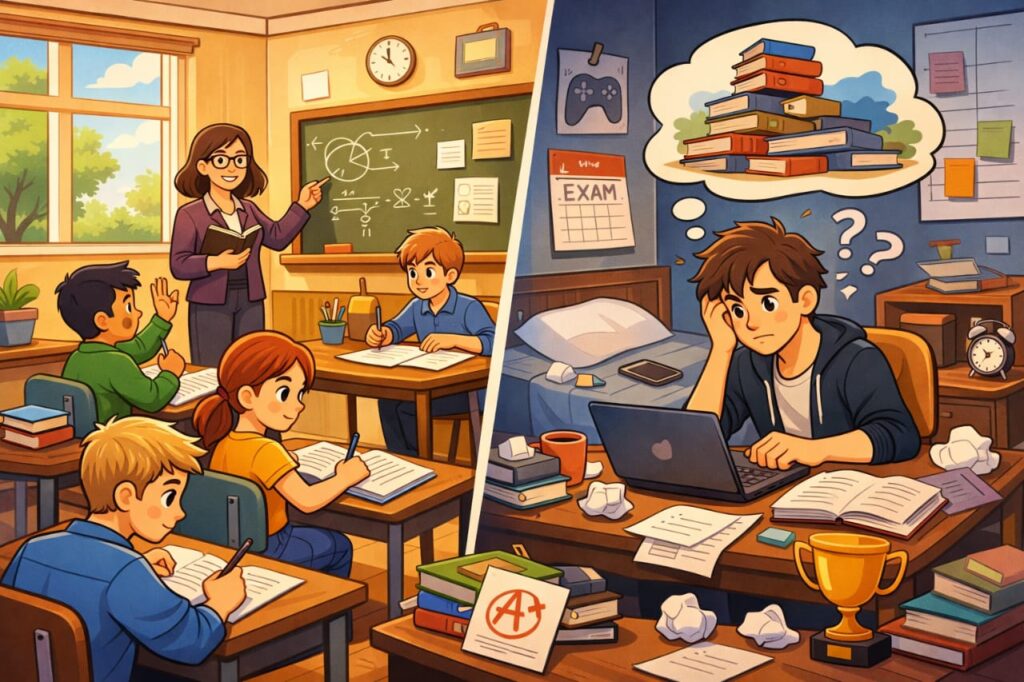
Many students believe that they can manage studies completely on their own with the help of books, notes, YouTube videos, and online resources. Some students do try to study alone and work very hard. However, over time, many of them face problems such as lack of consistency, confusion in concepts, and poor performance in tests.
Studying alone is not always the problem. Studying without guidance, structure, and feedback is the real problem. This is why classroom learning still plays an important role in a student’s academic journey.
Studying Alone Often Leads to Irregular Study Habits
When students study alone, they usually depend on their mood and motivation. Some days they study a lot, and some days they do not study at all.
Common problems students face while studying alone include:
Postponing difficult chapters
Studying only favourite subjects
Skipping revision
Not practising enough questions
Studying only before tests
Without a fixed routine, consistency becomes difficult, and consistency is very important in Classes 9–12.
Classroom learning creates a schedule and routine that keeps students regular and disciplined.
Students Do Not Always Know What Is Important
Another problem with studying alone is that students often do not know:
Which topics are most important
Which chapters need more practice
How questions are asked in exams
How to write answers properly
How to manage time during exams
Teachers guide students about important topics, exam patterns, and answer-writing methods. This direction saves time and improves performance.
Hard work without direction often does not give the expected results.
Doubts Remain Unsolved When Students Study Alone
When students study alone and do not understand a topic, they may:
Skip the topic
Memorise without understanding
Search random explanations online
Continue studying with confusion
These unresolved doubts become bigger problems in future chapters.
In classroom learning, students can ask doubts immediately and teachers can explain the concept again in a different way until the student understands.
Mistakes Do Not Get Corrected
One of the most important parts of learning is mistake correction.
When students study alone:
No one checks their answers
No one corrects their method
No one tells them where they are wrong
Students may continue making the same mistakes again and again.
In classroom learning:
Teachers check homework
Teachers conduct tests
Teachers explain mistakes
Students learn the correct method
This feedback helps students improve much faster.
Classroom Learning Builds Discipline and Confidence
Classroom learning provides:
Fixed study schedule
Regular homework
Regular tests
Teacher guidance
Competitive environment
Academic discipline
When students follow this system, they become more organised and confident.
Confidence grows when students:
Understand concepts
Perform better in tests
See improvement in their performance
This improvement happens faster with guidance and structured learning.
Self-Study Is Important, But Guidance Is Necessary
This does not mean students should not study on their own. Self-study is very important.
But the best combination is:
Classroom learning for guidance + Self-study for practice = Strong performance
Teachers provide direction and structure. Students provide effort and practice.
Both are necessary for academic success.
Final Takeaway
Studying alone may work for a few highly disciplined students, but most students perform better when they study in a classroom environment with proper guidance.
The problem is not self-study.
The problem is studying without direction, feedback, discipline, and guidance.
Classroom learning provides structure, doubt solving, mistake correction, and motivation. These things help students stay consistent and confident throughout the academic year.
Education is not just about studying harder.
It is about studying in the right direction with the right guidance.