In the last few years, online classes have become very common. Students can watch lectures, download notes, submit assignments online, and learn from home. Online education has made information easily available to everyone.
However, education is not only about information. Education is also about discipline, routine, focus, and guidance. This is where offline classes still play a very important role in a student’s academic development.
Many students who rely only on online learning have access to information, but they often struggle with consistency and discipline. Offline learning environments help students develop habits that are essential for long-term academic success.
Information Is Easily Available Today
Today, students can find almost any topic online. There are videos, notes, solutions, and explanations for almost every subject and chapter.
But having information is not the same as learning.
Learning requires:
- Regular study habits
- Practice and revision
- Doubt solving
- Tests and feedback
- Time management
- Discipline
Online platforms provide content, but they usually cannot ensure that students are studying regularly and correctly.
Offline Classes Create a Study Routine
One of the biggest advantages of offline classes is that they create a fixed routine.
Students:
- Attend classes at fixed times
- Revise topics regularly
- Complete homework on time
- Prepare for regular tests
This routine builds discipline. Over time, students become more organised and consistent in their studies.
Students who study only online often postpone lectures, delay homework, and study irregularly because there is no fixed system forcing them to stay consistent.
Focus Is Better in a Classroom Environment
When students attend offline classes, they are in an environment where everyone is studying. This improves concentration.
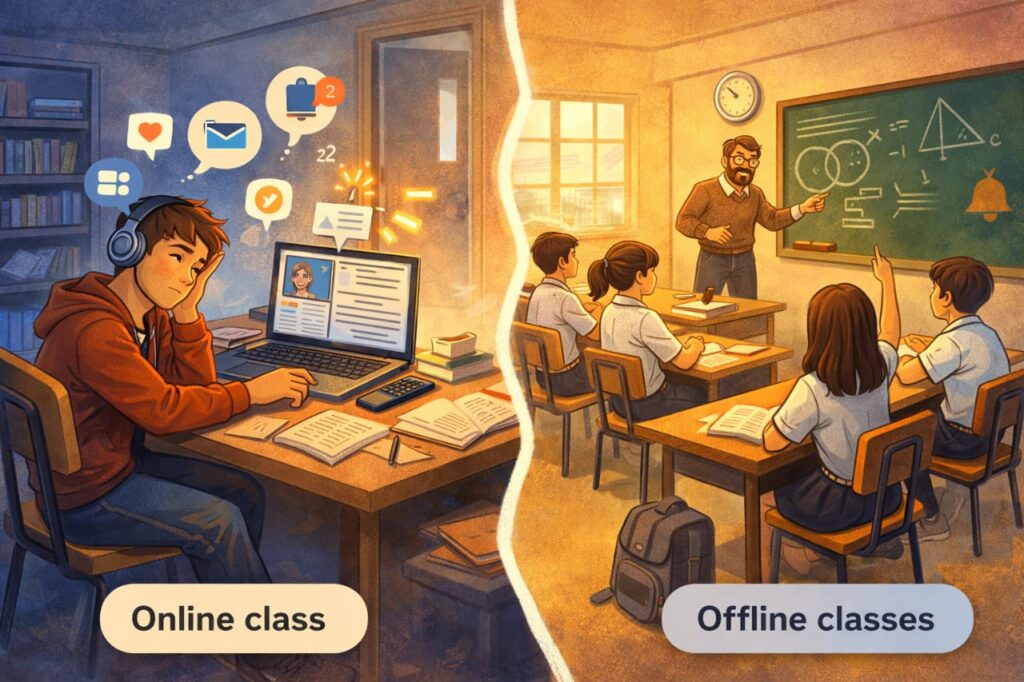
In online classes, students often face distractions such as:
- Mobile phones
- Social media
- Notifications
- Background noise at home
- Switching between apps
Even a small distraction can break concentration and reduce understanding.
A classroom environment helps students stay focused for longer periods.
Teachers Can Monitor Students Offline
In offline classes, teachers can observe students and understand:
- Who is paying attention
- Who is struggling with a topic
- Who is not completing homework
- Who needs extra practice
This monitoring helps students stay responsible and disciplined.
In online learning, it is much harder for teachers to monitor whether students are actually paying attention or just logged into a class.
Discipline Is More Important Than Motivation
Many students depend on motivation to study. But motivation changes from day to day.
Discipline, on the other hand, creates consistency.
Offline classes help students develop discipline by:
- Maintaining fixed schedules
- Conducting regular tests
- Giving regular assignments
- Monitoring progress
Students who develop discipline in Classes 9–12 usually perform better in board exams and competitive exams.
Learning Is Not Just Watching Lectures
Watching lectures online may feel like studying, but real learning includes:
- Listening
- Writing
- Practising questions
- Making mistakes
- Asking doubts
- Writing tests
- Getting feedback
This complete learning cycle happens more effectively in offline classes where teachers guide students continuously.
Final Takeaway
Online classes can provide information and explanations, but offline classes help students develop discipline, focus, and consistent study habits.
Information alone does not lead to academic success.
Discipline, practice, guidance, and regular feedback lead to academic success.
Students do not succeed because they watched more lectures.
They succeed because they studied regularly, practised consistently, and were guided properly.
Offline education helps build these habits, which support students not only in school exams but also in their long-term academic journey.