
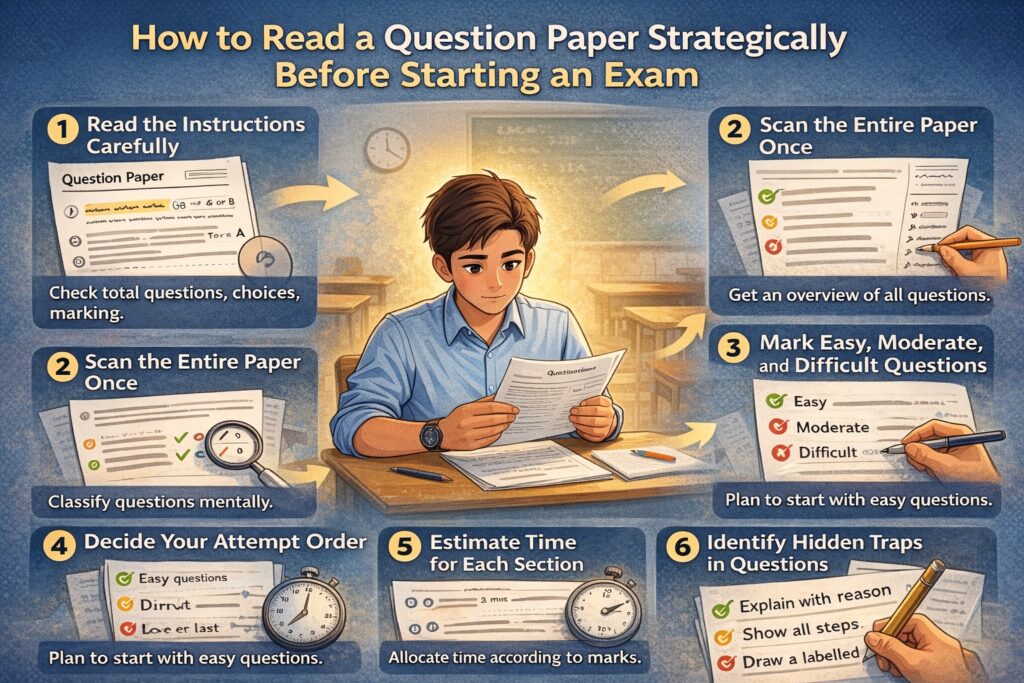
Many students lose marks not because they do not know the answers, but because they rush into writing without understanding the question paper properly. The first few minutes of an exam are extremely important. A calm and strategic reading of the paper can improve accuracy, time management, and confidence.
Learning how to read a question paper effectively is a skill that students can develop and practise before every exam.
Why the First 10–15 Minutes Matter
Most exams provide reading time at the beginning. This time is not meant for stress or panic. It is an opportunity to:
- Understand the structure of the paper
- Identify easy and difficult sections
- Plan time allocation
- Avoid careless mistakes
Students who use this time wisely often perform more consistently because they begin writing with clarity.
Step 1: Read the Instructions Carefully
Start by reading the instructions at the top of the question paper.
Look for:
- Total number of questions
- Internal choices
- Section-wise marking scheme
- Word limits or answer formats
Many students lose marks simply because they miss instructions about compulsory questions or optional choices.
Step 2: Scan the Entire Paper Once
Before focusing on individual questions, quickly scan the whole paper.
During this scan:
- Notice which sections look familiar
- Identify questions from strong topics
- Observe the length of long-answer questions
This overview reduces anxiety because the paper no longer feels unknown.
Step 3: Mark Easy, Moderate, and Difficult Questions
While reading, mentally classify questions into three categories:
- Easy: Questions you can answer confidently
- Moderate: Questions that require some thought
- Difficult: Questions that may need more time or revision
This mental mapping helps you decide where to start.
Step 4: Decide Your Attempt Order
Many students believe they must follow the paper strictly from the first question to the last. In most exams, this is not necessary.
A smart order often looks like:
- Easy questions first to build confidence
- Moderate questions once momentum builds
- Difficult questions later when most marks are secured
Starting with familiar questions reduces stress and improves writing flow.
Step 5: Estimate Time for Each Section
Before writing, quickly divide your total exam time according to marks.
For example:
- Short-answer questions require less time
- Long-answer questions need more planning
Keep a mental note of checkpoints so you do not spend too long on a single question.
Step 6: Identify Hidden Traps in Questions
Some questions appear simple but contain specific instructions such as:
- “Explain with reason”
- “Show all steps”
- “Draw a labelled diagram”
Underline keywords mentally while reading. This prevents incomplete answers later.
Step 7: Plan Your First Answer
Before you start writing:
- Choose a question you feel confident about
- Quickly outline key points in your mind
A strong first answer sets the tone for the rest of the paper and boosts confidence.
Common Mistakes Students Make While Reading the Paper
- Skipping instructions due to nervousness
- Starting with the longest question immediately
- Spending too much time deciding where to begin
- Misreading options or internal choices
- Letting anxiety prevent proper planning
Avoiding these mistakes can improve overall performance without extra study hours.
Practising This Skill Before Exams
Strategic reading becomes easier with practice.
Students can:
- Use sample papers and practise reading for 10 minutes before writing
- Simulate exam conditions at home
- Reflect after each test on whether time planning worked
Like any academic skill, effective paper reading improves with repetition.
How Parents Can Support Students
Parents can encourage students to:
- Stay calm during the reading time
- Avoid last-minute panic discussions before exams
- Practise mock tests with realistic timing
Confidence often grows when students feel prepared and supported.
Final Takeaway
Reading the question paper is not just a formality – it is a strategy that can shape the entire exam experience.
Students who:
- Read instructions carefully
- Scan the paper fully
- Plan their attempt order
- Manage time consciously
often perform better because they write with clarity rather than urgency.
Exams are not only about knowledge. They are also about how wisely you approach the paper from the very beginning.