
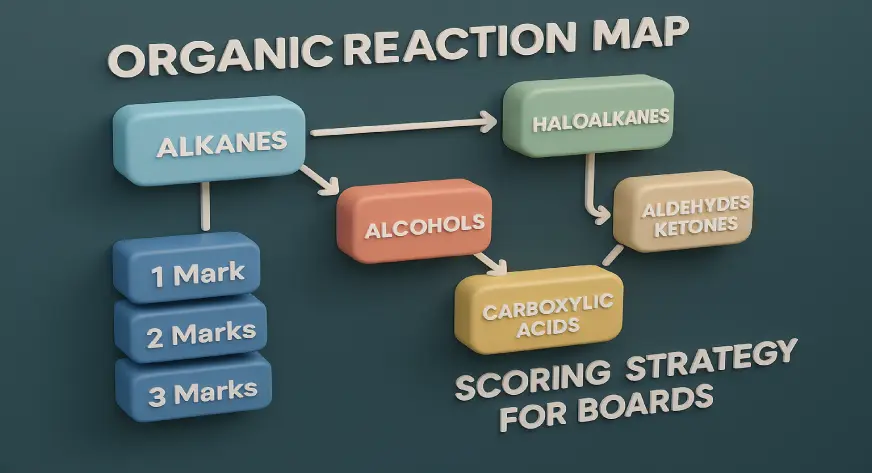
Organic Chemistry is one of the most scoring sections in the CBSE Class 12 Chemistry board exam – provided students prepare it in a structured, reaction-linked manner instead of memorising isolated reactions.
This blog is divided into three clear parts:
- Part A: CBSE-important Organic Reaction Map
- Part B: Board-oriented scoring strategy
- Part C: Last-week revision plan
If followed properly, this approach can significantly improve accuracy, presentation, and confidence in the exam.
Part A: Organic Reaction Map (CBSE-Important)
1. Haloalkanes & Haloarenes
Haloalkanes
- R–X ⟶ Alcohol : aq. KOH
- R–X ⟶ Alkene : alc. KOH
- R–X ⟶ Nitrile : KCN
- R–X ⟶ Isocyanide : AgCN
- R–X ⟶ Amine : Gabriel synthesis
- R–X ⟶ Higher alkane : Wurtz reaction
Haloarenes
- Chlorobenzene ⟶ Phenol : Dow’s process
- Chlorobenzene ⟶ Aniline : NH₃ + Cu₂O
CBSE frequently tests differences between SN1, SN2, E1, and E2 mechanisms, making this chapter extremely important for theory and reasoning questions.
2. Alcohols, Phenols & Ethers
Alcohols
- 1° alcohol ⟶ Aldehyde : PCC
- 1° alcohol ⟶ Acid : K₂Cr₂O₇ / KMnO₄
- 2° alcohol ⟶ Ketone
- Alcohol ⟶ Alkene : conc. H₂SO₄
- Alcohol ⟶ Haloalkane : HX / SOCl₂ / PCl₅
Phenols
- Phenol ⟶ Picric acid : conc. HNO₃
- Phenol ⟶ Salicylaldehyde : Reimer–Tiemann reaction
- Phenol ⟶ Anisole : Williamson synthesis
- Phenol ⟶ Benzene : Zn dust
These reactions frequently appear in conversions, reagent-based questions, and named reaction questions.
3. Aldehydes & Ketones
- Aldehyde ⟶ Acid : Tollens’ / Fehling’s reagent
- Aldehyde ⟶ Alcohol : NaBH₄
- Ketone ⟶ Alcohol : NaBH₄
- Carbonyl ⟶ Alkene : Wittig reaction
Important Named Reactions
- Aldol condensation
- Cannizzaro reaction (no α-hydrogen)
- Clemmensen reduction
- Wolff–Kishner reduction
The iodoform test is a very scoring and frequently asked question in CBSE exams.
4. Carboxylic Acids
- Acid ⟶ Acid chloride : SOCl₂
- Acid ⟶ Ester : Alcohol + conc. H₂SO₄
- Acid ⟶ Amide : NH₃
- Acid ⟶ Alkane : Soda lime (decarboxylation)
- Acid ⟶ Alcohol : LiAlH₄
This chapter is often tested through stepwise conversions and reagent identification.
5. Amines
- Amine ⟶ Diazonium salt : NaNO₂ + HCl (0–5°C)
- Diazonium ⟶ Phenol : Warm water
- Diazonium ⟶ Halobenzene : Sandmeyer reaction
- Aniline ⟶ Acetanilide : Acetylation
Diazonium salts are guaranteed CBSE questions and should never be skipped.
6. Biomolecules (Direct Theory Marks)
- Glucose: structure and reactions
- Sucrose: non-reducing sugar
- Amino acids: zwitter ion
- Proteins: peptide linkage
- Vitamins: A, B₁, C, D (sources and deficiency diseases)
This chapter provides direct, theory-based scoring opportunities.
Part B: CBSE Board Scoring Strategy
1. Write Reagents Clearly
Always use neat arrows and conditions, for example:
CH₃CH₂OH ──PCC──▶ CH₃CHO
Clear presentation directly impacts marks.
2. Named Reactions = Free Marks
Always write the name of the reaction:
- Gabriel synthesis
- Aldol condensation
- Reimer–Tiemann reaction
Even if the product is correct, missing the reaction name can lead to mark deduction.
3. Mechanism-Based Questions
CBSE expects:
- Curved arrows
- Reaction intermediates
- Clear identification of reaction type (SN1 / SN2 / E1 / E2)
4. Conversion Questions (5 Marks)
Golden rule: Change one functional group at a time.
Example:
- Alcohol ⟶ Alkene
- Haloalkane ⟶ Amine
Skipping steps leads to loss of marks even if the final product is correct.
5. Reason-Based Questions
Use precise scientific terms such as:
- +I effect
- Resonance
- Steric hindrance
- Hyperconjugation
Using the correct term usually fetches full marks.
If you are Looking for Career options after 12th Class, Checkout this article!
Part C: Last-Week Revision Plan (CBSE)
Day 1
- Haloalkanes & Alcohols
- Phenols & Ethers
Day 2
- Aldehydes & Ketones
- Carboxylic Acids
Day 3
- Amines & Diazonium salts
- Biomolecules
Day 4
- Previous Year Questions
- Reaction map revision
- Conversion practice
Also Read, How to Choose the Right Coaching Institute in North Delhi
Final CBSE Tip
If you:
- Remember the reaction map
- Write correct conditions and reaction names
- Avoid skipping steps in conversions
Then scoring 90%+ in Organic Chemistry is very achievable.