
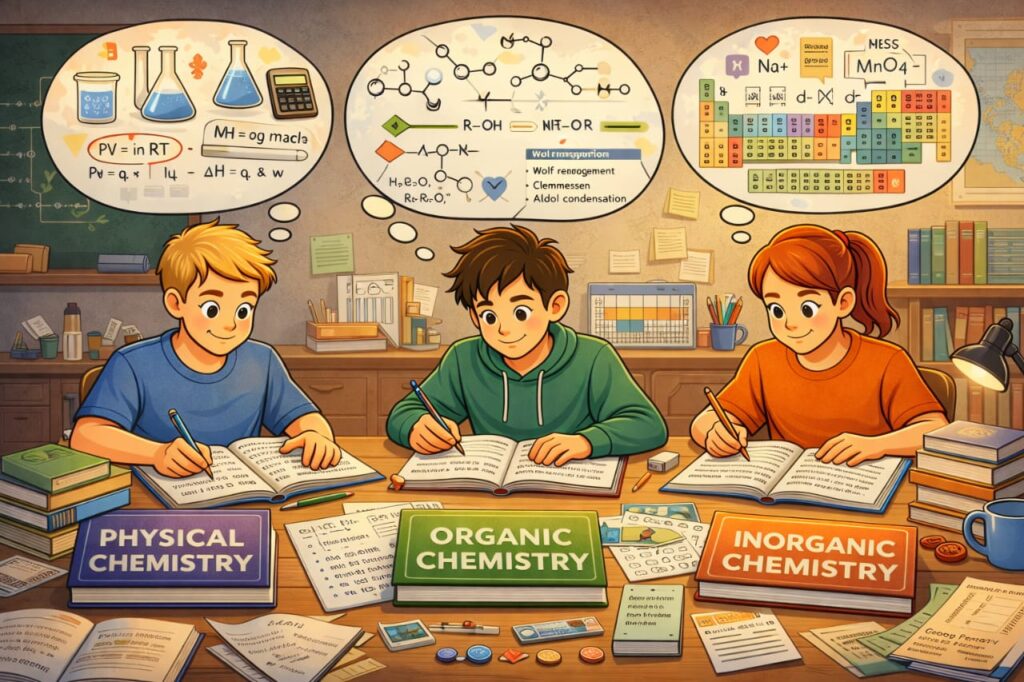
Many students find Chemistry confusing in Classes 11 and 12 because it is divided into three different parts:
- Physical Chemistry
- Organic Chemistry
- Inorganic Chemistry
Each part requires a different study approach. Many students try to study all three in the same way, which makes Chemistry difficult and confusing.
Chemistry becomes much easier when students use a different strategy for each part.
Physical Chemistry – Practice and Numericals
Physical Chemistry is similar to Physics and Mathematics because it involves formulas, numericals, and calculations.
To study Physical Chemistry effectively:
- Understand the concept first
- Learn the formulas
- Practise numericals regularly
- Write proper steps while solving
- Revise formulas frequently
Chapters like mole concept, solutions, thermodynamics, and electrochemistry require a lot of numerical practice. Students who practise regularly usually score well in Physical Chemistry.
Organic Chemistry – Reactions and Mechanisms
Many students find Organic Chemistry difficult, but it becomes easier if studied properly.
Organic Chemistry is mainly about:
- Reactions
- Reaction mechanisms
- Conversions
- Named reactions
To study Organic Chemistry:
- Understand reaction mechanisms
- Learn how reactions happen
- Write reactions again and again
- Practise conversions
- Make a reaction chart
Organic Chemistry cannot be learned by reading only. Students must write reactions regularly to remember them.
Inorganic Chemistry – Concepts and Memory
Inorganic Chemistry involves theory, chemical properties, and periodic table concepts.
To study Inorganic Chemistry:
- Read NCERT carefully
- Make short notes
- Learn important reactions and properties
- Revise regularly
- Focus on periodic trends
Inorganic Chemistry requires regular revision because students may forget details if they do not revise.
Make Separate Notes for Each Part
Students should maintain separate notes for:
- Formulas (Physical Chemistry)
- Reactions (Organic Chemistry)
- Important points (Inorganic Chemistry)
These notes help a lot during revision before exams.
Practice Is Very Important in Chemistry
To score well in Chemistry, students should practise:
- Numericals
- Chemical reactions
- Conversion questions
- Previous year questions
- Sample papers
Practice improves speed and accuracy in exams.
Revision Is the Key to Chemistry
Chemistry has many formulas, reactions, and concepts. Without revision, students forget topics quickly.
Students should:
- Revise formulas weekly
- Revise reactions regularly
- Revise important points from notes
- Solve previous year questions
Regular revision makes Chemistry easier.
Final Takeaway
Chemistry becomes difficult when students try to study all parts in the same way.
Chemistry becomes easier when students follow:
- Practice for Physical Chemistry
- Reaction writing for Organic Chemistry
- Revision and notes for Inorganic Chemistry
With the right strategy, Chemistry can become a scoring subject in Classes 11 and 12.